Why Is My Skin Breaking Out Now That Summer Is Ending?
Quick Answer: Late-summer breakouts usually trace to one of four causes: a delayed reaction to accumulated sun exposure and heavy sunscreen use, the return of a stressful schedule, a change in sweat and shower timing, or the tail end of summer’s higher oil production meeting drier air. The most common single error is responding by stripping and over-drying the skin, which worsens it. Identify which of the four applies before changing products.
You had clear skin all July and now, as the weather cools, everything is breaking out.
This pattern is common enough to be predictable, and the cause determines the fix.
This is general information, not medical advice. Persistent, painful, or scarring acne is worth seeing a dermatologist about - effective prescription options exist.

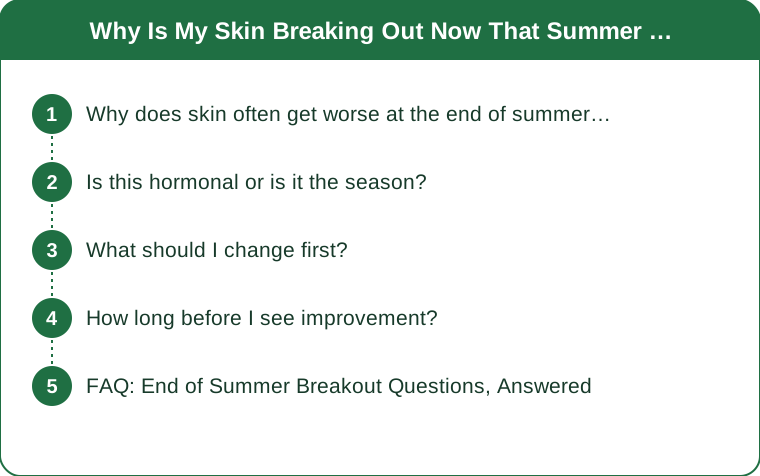
Why does skin often get worse at the end of summer rather than during it?
Because several summer effects are delayed rather than immediate.
Sun exposure has a deferred cost. UV exposure can temporarily suppress inflammation and dry surface oil, which is why acne often appears to improve in summer. But UV also thickens the outer layer of skin over time. That thickening can trap oil and dead cells in pores, and the resulting congestion shows up weeks later - typically late summer into early autumn.
This is why the “sun helps my acne” experience is followed by a September rebound so consistently.
Accumulated product residue plays a part. A summer of daily sunscreen, often reapplied, sometimes water-resistant, is a lot of product. Water-resistant formulations are designed to stay put, and if cleansing wasn’t thorough, that residue accumulates in pores across a season.
Sweat itself doesn’t cause acne, but timing does. Sweat left on the skin under clothing, hats, or equipment creates a warm occluded environment that encourages congestion. A summer of delayed post-workout showers has a cumulative effect.
Then the season changes and oil production is still elevated while the air gets drier - a combination of congestion and surface dehydration at the same time. Skin that’s simultaneously oily and tight is a genuinely confusing state, and it’s what leads most people to the wrong treatment.
Is this hormonal or is it the season?
Both can be true, and there are ways to tell them apart.
Hormonal patterns typically show as:
- Location along the jawline, chin and lower cheeks
- Deeper, tender lesions rather than surface bumps
- Timing tied to the menstrual cycle - commonly the week before a period
- Recurrence in the same spots
Seasonal or congestion-driven patterns typically show as:
- Forehead, nose and upper cheeks more than the jaw
- Smaller closed bumps and blackheads rather than deep cysts
- Widespread texture change rather than distinct spots
- No clear cycle timing
Stress-related flares are their own thing and often overlap with September. Stress raises cortisol, which can increase oil production and inflammation, and the return of a demanding schedule is a genuine physiological input rather than a vague one.
Track it for one cycle before changing much. Note location, type and date - a month of that data tells you more than any product trial. If the pattern is clearly hormonal, the useful conversation is with a doctor, since the effective treatments are different.
One thing worth checking: any product you changed in the last six to eight weeks, including hair products. Pomades, conditioners, and heavy hair oils cause breakouts along the hairline and upper back and are consistently the most overlooked cause.

What should I change first?
In order of impact, and the first one is subtraction.
1. Stop stripping the skin. The instinctive response to breakouts is stronger cleansers, more acids, more drying spot treatments. This damages the barrier, which increases inflammation, which worsens acne. The cycle is extremely common.
What to do instead: one gentle cleanser, twice daily maximum, no scrubbing. If your skin feels tight after cleansing, the cleanser is too harsh.
2. Actually double cleanse in the evening, at least while you’re still using sunscreen daily. An oil or balm cleanser first to break down sunscreen, then a gentle water-based cleanser. This directly addresses the residue accumulation, and it’s the highest-value single change for a lot of people at this time of year.
3. Keep moisturising. Oily, breaking-out skin still needs moisture. A dehydrated barrier produces more oil in response, so under-moisturising makes oiliness worse. A light gel or lotion works.
4. One active, not four. Salicylic acid for congestion and blackheads; benzoyl peroxide for inflammatory spots; adapalene for both, with a slower timeline. Pick one, use it consistently for eight to twelve weeks, and judge it then.
5. Shower promptly after sweating. If that’s impossible, at minimum change out of damp clothing and use a gentle cleansing wipe on affected areas.
What not to do: change everything at once. You’ll have no idea what worked, and multiple new products simultaneously is itself a common cause of irritation.
How long before I see improvement?
Longer than most people allow, and knowing the timeline prevents abandoning something that’s working.
Skin cell turnover takes roughly a month, and a spot visible today began forming weeks ago. Any treatment needs at least one full turnover cycle before you can judge it.
Realistic timelines:
- Weeks 1-2 - little visible change. Some products cause an initial worsening
- Weeks 4-6 - first genuine signs of improvement
- Weeks 8-12 - the point at which you can fairly assess whether it’s working
- Beyond 12 weeks with no improvement - time to change approach or see a doctor
On purging versus breaking out: purging happens with ingredients that accelerate cell turnover - retinoids, some acids - and appears in your usual breakout areas, resolving faster than normal spots. It typically settles within four to six weeks.
Breaking out from a product appears in new areas, includes different types of lesions, and doesn’t settle. If it’s been more than six weeks and still worsening, it’s not purging.
Post-inflammatory marks last much longer than the spots. The dark or red marks left behind can take months to fade. Sunscreen is the single most effective thing for that specific problem - UV exposure prolongs them considerably, which is another reason not to drop it in autumn.
When to see a doctor rather than continue experimenting: painful deep lesions, scarring, no improvement after three months of consistent over-the-counter treatment, or a significant effect on how you feel day to day. That last one is a legitimate reason on its own.
FAQ: End of Summer Breakout Questions, Answered
Should I stop wearing sunscreen if it’s breaking me out?
No - change the formula rather than dropping it. Fluid, gel, or mineral-based sunscreens suit acne-prone skin better than thick water-resistant creams. Sunscreen also fades post-acne marks faster by preventing them darkening, so it’s helping with the thing that bothers people most.
Does diet actually matter?
The evidence is strongest for high-glycaemic diets and, for some people, dairy - particularly skim milk. It’s a contributing factor rather than the cause for most people, and worth a four-week trial of reducing one variable rather than an overhaul.
Why does my skin look oily and feel tight at the same time?
Dehydration and oiliness coexist easily - oil and water are different things. Stripping products cause exactly this. A gentle cleanser plus a light moisturiser usually resolves it within a couple of weeks.
Is it worth changing my pillowcase more often?
It’s a reasonable low-cost habit and unlikely to be the main driver. Hair products transferring onto the pillow matter more than the pillowcase itself, so washing hair before bed after using styling products often does more.
Can stress really cause breakouts?
Yes - stress affects oil production and inflammation through hormonal pathways, and there’s reasonable evidence linking stress periods to acne severity. September is a genuine stress spike for a lot of people, and treating it as a real input rather than an excuse is more useful.
TL;DR:
- Late-summer breakouts often come from delayed UV effects, accumulated sunscreen residue, sweat timing, and a return of stress
- Sun appears to help acne short term and can drive congestion that surfaces weeks later
- The most common mistake is stripping the skin, which damages the barrier and worsens inflammation
- Double cleanse in the evening while still using daily sunscreen - this is the highest-value change
- One active, eight to twelve weeks, before judging it
- Keep the sunscreen: it’s also the most effective thing for fading post-acne marks
Identify which of the four causes applies before you change a single product.
Keep Reading
This article is for general informational purposes only and is not medical advice. Always consult a qualified health professional for guidance specific to you.