Why Do Scarves and Turtlenecks Break Out Your Jaw and Neck?
Quick Answer: This is acne mechanica - breakouts caused by friction, pressure, heat, and trapped moisture rather than by dirt. A collar or scarf rubs against skin, traps warmth and sweat against the jaw and neck, and the combination irritates the follicle wall and encourages blockage. It typically appears seven to fourteen days after you start wearing the item, in the exact pattern of the contact. The fixes are fabric choice, laundering the item far more often than feels necessary, and a barrier layer - not more aggressive cleansing, which usually makes it worse.
The jumpers came out last week. The jawline spots arrived this week. It seems like a coincidence, or possibly just the season changing.
It is neither. The pattern is specific enough to diagnose from where the spots are.

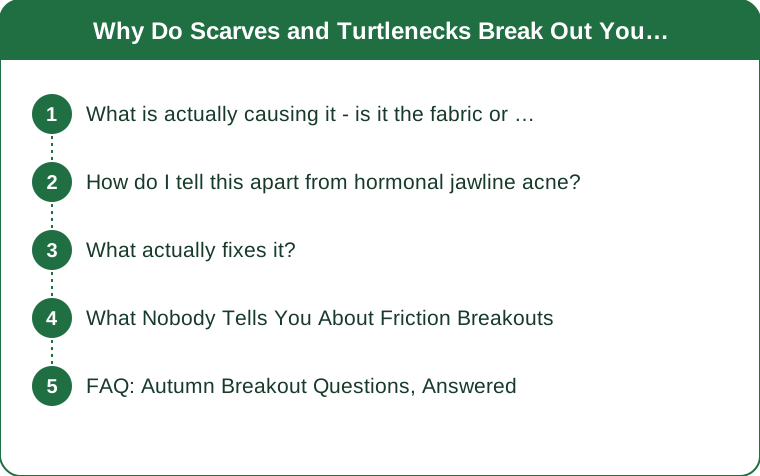
What is actually causing it - is it the fabric or the dirt?
Primarily friction and trapped heat. Dirt is a minor contributor and the one people over-treat.
The mechanism is well described in dermatology as acne mechanica, the same category as breakouts from helmet straps, sports bras, and face masks. Four factors work together:
Friction. Repeated rubbing irritates the follicle opening and disrupts the skin barrier. A collar that moves every time you turn your head produces thousands of small friction events a day.
Occlusion. Fabric held against skin traps sebum and sweat that would otherwise evaporate. A blocked follicle in a warm moist environment is close to ideal conditions for the process that produces a spot.
Heat and moisture. Sweat and warmth increase bacterial activity, and the C. acnes bacteria involved in inflammatory acne thrive in exactly that environment.
Pressure. A tight collar or a wrapped scarf physically compresses follicles.
The fabric matters, and mostly through moisture behaviour:
- Wool is the most frequently blamed and the reason is often irritation rather than blockage. Coarser wool fibres are mechanically irritating to the skin barrier, which is a different problem than a blocked pore, though it produces similar-looking results.
- Acrylic and polyester do not absorb moisture, so sweat sits between fabric and skin.
- Cotton absorbs but then stays damp against the skin.
- Merino and silk are generally the best tolerated - fine fibres, low friction, and good moisture handling.
Why does it show up on the jawline specifically?
Because that is where the contact is. The jawline, the sides of the neck, and the area just under the chin are where a collar or scarf sits and moves. The distribution follows the garment, which is the single most useful diagnostic feature - hormonal jawline acne tends to be deeper, more cyclical, and does not map so precisely onto where fabric touches.
How do I tell this apart from hormonal jawline acne?
Four differences, and the timing is the clearest one.
Timing. Friction acne appears seven to fourteen days after starting a new contact pattern and persists as long as the contact does. Hormonal acne follows your cycle, typically flaring in the week before your period.
Distribution. Friction acne maps to the garment - a clean line where the collar sits, or a band where the scarf wraps. Hormonal acne clusters around the lower face and chin in a broader, less defined pattern.
Lesion type. Friction acne tends toward small uniform papules and pustules, often with some general redness of the whole contact area. Hormonal acne more often produces deeper, tender nodules that take longer to resolve.
Symmetry. Friction acne is often asymmetric, following how you actually wear the thing - worse on the side you tuck the scarf, or where the collar bunches. Hormonal breakouts are usually more symmetrical.
Can it be both?
Frequently, and that is worth knowing before you conclude that a treatment failed. A hormonal pattern plus a new friction source in autumn produces a worse flare than either alone, and removing the friction component can be enough to bring the whole thing back to manageable even if the hormonal component is unchanged.
This is general information, not medical advice. Persistent or painful cystic acne is worth seeing a dermatologist about - it responds to treatment and it scars if left.

What actually fixes it?
Address the contact first. Skincare changes are the second lever, not the first.
What to change about the garment
Wash it far more often than feels necessary. A scarf worn against the skin daily should be washed weekly at minimum. Most people wash outerwear seasonally, and a scarf is functionally underwear in terms of skin contact.
Choose fine fibres. Merino, silk, or a soft cotton jersey rather than coarse wool or acrylic. If you love a particular wool scarf, a silk or cotton layer between it and your skin solves it entirely.
Loosen it. A scarf draped rather than wrapped tight reduces both pressure and heat trapping considerably.
Rotate items. Two scarves alternated is meaningfully better than one worn every day, because each gets time to dry out fully.
Take it off indoors. The heat and moisture build-up happens mostly when you keep a scarf on in a warm building. This is the highest-value single change and the easiest to forget.
What to change about your skin routine
Do not escalate cleansing. The instinct is to scrub, and it is wrong - the skin barrier is already compromised by friction, and aggressive cleansing or exfoliating makes irritation worse. Gentle cleanser, twice a day.
A light salicylic acid product on the affected area two or three times a week helps keep follicles clear. Beta hydroxy acids are the appropriate class here because they are oil-soluble and get into the follicle.
A lightweight barrier layer. A thin non-comedogenic moisturiser between skin and fabric reduces friction directly. Counterintuitive if you are used to treating oily skin by stripping it, and genuinely effective.
Cleanse after, not just in the morning. If you have worn a scarf all day, a gentle cleanse when you get home removes several hours of trapped sweat before it sits there all evening.
Give it three to four weeks. Skin cell turnover means changes take that long to show. Judging a fix after five days is how people conclude nothing works.
What Nobody Tells You About Friction Breakouts
The laundry detergent is a genuine suspect and almost nobody checks it.
Fragrance and residual detergent in a garment held against warm damp skin for eight hours is a meaningful irritant, and it produces something that looks a lot like friction acne. If breakouts appeared with a whole new season of knitwear rather than one item, try washing the lot in a fragrance-free detergent with an extra rinse before you conclude it is the fabric.
Fabric softener is worse. It leaves a cationic film on fibres that both holds fragrance against the skin and reduces the fabric’s ability to manage moisture.
The dry cleaning question. Wool items that get dry cleaned rather than washed carry solvent residue, which is another irritation source. Airing a dry cleaned item for a day or two before wearing it against your neck is worth doing.
New knitwear sheds. Fine fibre fragments from a new wool or mohair item are mechanically irritating in a way the same garment will not be after three washes. Wash new knitwear before wearing it near your face.
And the pattern repeats every year. Autumn friction acne is seasonal and predictable, which means it is preventable. If you got it last October, the useful move is to wash and prepare the knitwear before the first cold week rather than diagnosing it again ten days in.
FAQ: Autumn Breakout Questions, Answered
Is it the wool itself or something on the wool?
Often both. Coarse wool fibres are mechanically irritating, and detergent residue, fabric softener, or dry cleaning solvent add a chemical irritant on top. Try a fragrance-free wash with an extra rinse first - it is the cheapest test and it resolves a surprising share of cases.
Should I stop wearing turtlenecks entirely?
Not necessarily. A merino or silk-blend turtleneck worn loose, washed weekly, and taken off in warm buildings causes far fewer problems than a tight acrylic one worn all day. Change the variables before you abandon the category.
Why did this never happen to me before?
Skin changes, and so do the specific garments. A new coat with a higher collar, a different detergent, or simply a warmer indoor environment can each be enough. It can also be a hormonal shift coinciding with the season, which is why the distribution pattern is worth checking.
How long until it clears once I fix the friction?
Existing lesions take their normal course - roughly one to two weeks for superficial ones. New ones should stop appearing within a week or two of removing the cause. If you see no change after four weeks of genuine changes, it is worth seeing a dermatologist, since it may not be friction acne at all.
TL;DR:
- This is acne mechanica - friction, pressure, heat, and trapped moisture, not dirt.
- It appears seven to fourteen days after the contact starts and maps to where the fabric touches.
- Distinguish from hormonal acne by timing, distribution, and asymmetry. It can be both.
- Take the scarf off indoors - the biggest single change, and the easiest to forget.
- Choose merino or silk over coarse wool and acrylic, wash it weekly, and rotate two items.
- Do not escalate cleansing. The barrier is already irritated. Gentle cleanser, light salicylic acid, and a thin barrier moisturiser.
- Check the detergent and fabric softener before blaming the fabric, and wash new knitwear before wearing it.
If your skin does this every October, treat it as a scheduled event rather than a mystery. Washing the knitwear and switching detergent before the first cold week is a ten-minute job that skips the whole thing.
Keep Reading
This article is for general informational purposes only and is not medical advice. Always consult a qualified health professional for guidance specific to you.