Starting Retinol in Fall: Your Questions, Answered
Quick Answer: Fall is the recommended window because UV exposure drops and retinol increases photosensitivity. Start at the lowest available strength, twice a week, applied to completely dry skin, buffered with moisturizer. Expect a rough patch at weeks 2 to 6 - dryness, flaking, and sometimes a purge. Do not increase frequency until you have had four consecutive comfortable weeks.
Most retinol failures happen because people go too fast in the first month and conclude their skin cannot tolerate it. Almost all of them could have, more slowly.

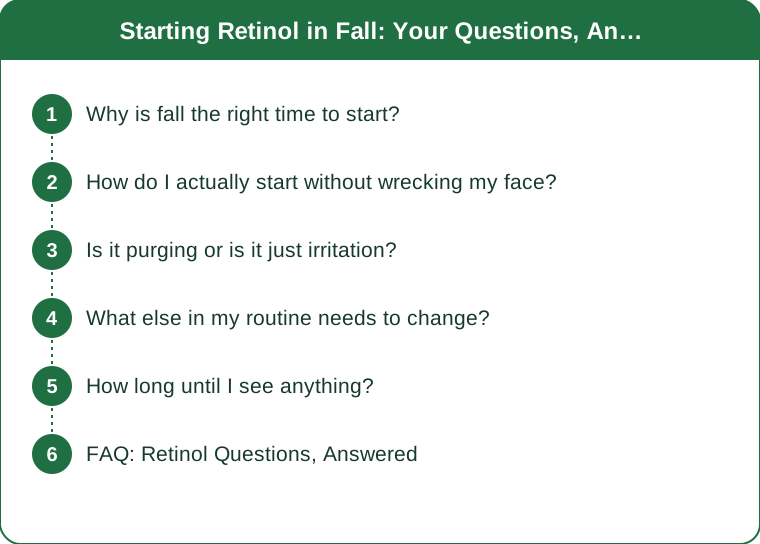
Why is fall the right time to start?
Two reasons, one obvious and one not.
The obvious one: retinoids increase photosensitivity and accelerate cell turnover, which exposes newer, less protected skin. Less intense UV and fewer hours outdoors both reduce the risk of the irritation-plus-sun-damage combination.
The less obvious one: the retinization period takes 8 to 12 weeks, and starting in September means you have adapted before winter’s dry indoor heat arrives. Starting in December means fighting retinol adjustment and low humidity simultaneously, which is when most people quit.
One caution that cuts against fall specifically: humidity is dropping right now in most of the country. Your skin is already getting drier from the environment. Factor that in - the same routine that felt fine in July may not in October, retinol or not.
How do I actually start without wrecking my face?
The protocol that has the best success rate is slower than most product instructions suggest.
Weeks 1 to 4: twice a week, Monday and Thursday. A pea-sized amount for the whole face. Skin must be completely dry - wait 20 to 30 minutes after cleansing, because damp skin absorbs more and irritates more.
Weeks 5 to 8: if the first four weeks were comfortable, move to every other night.
Weeks 9 onward: if still comfortable, nightly. Many people never need to get here. Three to four nights a week produces most of the benefit.
Buffer from the start: moisturizer, wait 10 minutes, then retinol, then moisturizer again. The sandwich method reduces irritation substantially and, contrary to a common worry, does not meaningfully reduce efficacy.
And avoid the eye area, the corners of the nose, and the neck for the first month. Those go last, at half frequency.
Is it purging or is it just irritation?
The distinction is about location and timing.
Purging appears in places you already break out, arrives within the first 2 to 6 weeks, and consists of the same kind of spots you normally get - just more of them, faster. Individual spots resolve on their normal timeline. It typically settles by week 6 to 8.
Irritation appears where you do not normally break out, includes stinging, tightness, flaking, or a rashy texture rather than distinct spots, and does not follow your usual pattern.
Purging is a reason to hold your current frequency and wait. Irritation is a reason to back off - drop to once a week, buffer more heavily, and rebuild.
What is not normal either way: swelling, weeping, spreading redness, or a burning sensation that persists after rinsing. Those warrant stopping and speaking to a clinician. This is general information, not medical advice.

What else in my routine needs to change?
Less than you think, but the changes are non-negotiable.
Add daily sunscreen, SPF 30 or higher, regardless of season or weather. This is the one genuinely mandatory pairing. Retinol without daily sun protection undoes much of what it is doing.
Pause other actives during the introduction. Exfoliating acids, benzoyl peroxide, and vitamin C all on the same nights as retinol is the fastest route to a compromised barrier. Move them to alternate nights, or drop them for the first month entirely.
Simplify everything else. A gentle cleanser, retinol, a bland moisturizer. Four to five products total. This is not the month to try three new things.
Increase moisturizer, do not decrease it. People often assume flaking means they need to exfoliate. It means the barrier needs support. A richer cream, an occlusive at night, or a humidifier as the indoor heating starts.
How long until I see anything?
Longer than the marketing implies, and the sequence is fairly predictable.
- Weeks 1 to 2: usually nothing visible.
- Weeks 2 to 6: the rough patch. Dryness, flaking, possible purge. This is where most people quit.
- Weeks 8 to 12: texture starts to smooth. Skin feels different before it looks different.
- Weeks 12 to 24: visible improvement in tone and fine lines for most people.
- Month 6 and beyond: collagen-related changes, which are the slowest and most durable.
The single most useful thing you can do is take a photo on day one, in the same light, and then not look at your skin closely for eight weeks. Daily mirror checks during weeks 2 to 6 are how good routines get abandoned.
Strength matters less than consistency. A low-strength retinol used four nights a week for a year beats a high-strength one used erratically for three months and then abandoned.
FAQ: Retinol Questions, Answered
Should I start with retinol or retinaldehyde?
Retinol is the standard starting point and the most studied over-the-counter option. Retinaldehyde is a step stronger with somewhat faster results and more irritation potential. Either is a reasonable first choice; the frequency protocol matters more than which you pick.
Can I use retinol if I am pregnant or breastfeeding?
Retinoids are generally advised against in pregnancy. Speak to your doctor or midwife before using any retinoid, and ask about alternatives like azelaic acid. This is general information, not medical advice.
Do I need to stop retinol in summer?
Not necessarily, but many people reduce frequency during high-UV months and use a higher SPF. Daily sunscreen matters more than the calendar.
TL;DR:
- Fall is the best starting window: less UV, and you finish adapting before winter dryness hits.
- Start at the lowest strength, twice a week, on completely dry skin, buffered with moisturizer.
- Purging appears where you already break out within weeks 2 to 6; irritation appears elsewhere with stinging and flaking.
- Daily SPF 30 or higher is mandatory, not optional.
- Pause other actives for the first month and increase, do not decrease, moisturizer.
- Take a day-one photo and stop examining your skin for eight weeks.
The people who succeed with retinol are not the ones with tougher skin. They are the ones who went slower than the box said. This is general information, not medical advice.
Keep Reading
This article is for general informational purposes only and is not medical advice. Always consult a qualified health professional for guidance specific to you.