Salicylic Acid or Benzoyl Peroxide: Which One Actually Clears Your Acne Faster?
Quick Answer: Benzoyl peroxide generally clears active, inflamed breakouts faster because it kills acne-causing bacteria directly, while salicylic acid works more gradually by exfoliating inside the pore — making it better for blackheads and preventing future breakouts than for putting out an active flare-up fast.
Standing in the skincare aisle staring at two nearly identical-looking tubes is its own kind of frustrating, especially when both claim to ‘fight acne’ on the front label without explaining that they’re solving different parts of the problem. Here’s what actually separates them, and how to figure out which one your specific breakout needs.
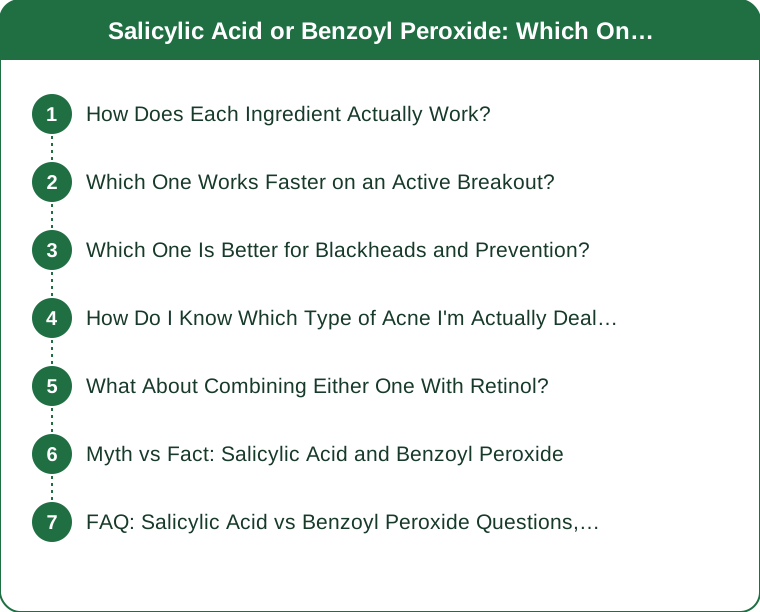
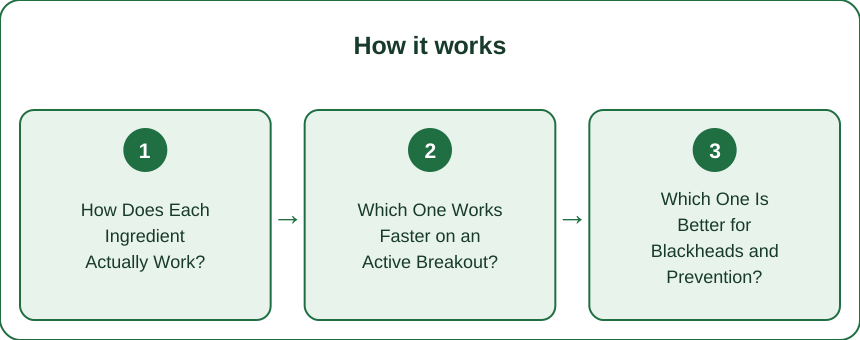
How Does Each Ingredient Actually Work?
Benzoyl peroxide works by releasing oxygen into the pore, which kills C. acnes bacteria (the bacteria most associated with inflamed, red breakouts) on contact through an oxidative process the bacteria can’t survive. Salicylic acid is oil-soluble, which lets it penetrate into the pore lining and dissolve the buildup of dead skin cells and oil that clogs pores in the first place — it’s exfoliating rather than antibacterial, working on the mechanical clog rather than the bacterial population directly.
This mechanism difference is why dermatologists often describe benzoyl peroxide as treating the ‘infection’ side of acne and salicylic acid as treating the ‘congestion’ side — two related but genuinely distinct problems that happen to show up together in most acne-prone skin.
Which One Works Faster on an Active Breakout?
For a red, inflamed, already-forming pimple, benzoyl peroxide typically shows visible improvement within 24-48 hours because it directly targets the bacteria driving the inflammation, often visibly reducing size and redness by the second day of spot treatment. Salicylic acid works on a slower timeline — it’s better suited to preventing the next breakout by keeping pores clear than to resolving one that’s already inflamed today, and using it alone on an active cystic breakout often leaves people frustrated at the lack of fast visible change.
Which One Is Better for Blackheads and Prevention?
Salicylic acid is the better long-term pick for blackheads, whiteheads, and general pore congestion, since its exfoliating action addresses the clogging mechanism directly rather than the bacterial component that isn’t really the primary driver of a blackhead in the first place. Using benzoyl peroxide for blackheads specifically is often overkill — it’s solving a bacterial problem that blackheads don’t primarily have, and can cause unnecessary dryness for a result salicylic acid achieves more comfortably.
How Do I Know Which Type of Acne I’m Actually Dealing With?
Red, tender, inflamed bumps point toward benzoyl peroxide. Small bumps, blackheads, and rough clogged-pore texture without much redness point toward salicylic acid. Many people end up using both — benzoyl peroxide as a targeted spot treatment on active breakouts, salicylic acid as a regular cleanser or toner for overall pore maintenance — since most real-world skin has a mix of both types of blemish happening at once rather than one clean category.
What About Combining Either One With Retinol?
Both ingredients can be combined with retinol, but the combination needs more care than pairing either one alone. Retinol and benzoyl peroxide used at the same time historically raised concerns about the benzoyl peroxide deactivating certain older retinol formulations, though most modern stabilized retinoid products no longer have this issue — the bigger practical concern is simply combined dryness and irritation from stacking three active ingredients on sensitive facial skin. Salicylic acid and retinol are both exfoliating in different ways, which means using them on the same night often compounds irritation rather than compounding benefit.
A workable rotation: salicylic acid cleanser in the morning, retinol at night on 3-4 nights a week, benzoyl peroxide spot treatment only on the nights retinol isn’t applied. This spacing lets each ingredient do its job without the skin barrier taking on more active ingredients than it can comfortably handle at once.
Myth vs Fact: Salicylic Acid and Benzoyl Peroxide
Myth: higher concentration always means faster, better results. Fact: benzoyl peroxide above 5-10% doesn’t clear breakouts meaningfully faster than lower concentrations in most studies, but it does increase dryness and irritation risk substantially — the same logic applies to salicylic acid, where 2% is the standard effective over-the-counter strength.
Myth: you should apply these ingredients all over your face daily regardless of where breakouts are. Fact: spot-treating just the affected area, especially with benzoyl peroxide, reduces unnecessary dryness on clear skin while still delivering the ingredient exactly where it’s needed most.
Myth: natural remedies like tea tree oil work just as well as these two ingredients. Fact: tea tree oil has some genuine antibacterial evidence and can be a mild option for very sensitive skin, but it’s meaningfully weaker in clinical comparisons than either salicylic acid or benzoyl peroxide for moderate acne — a reasonable gentler option, not an equivalent substitute.
FAQ: Salicylic Acid vs Benzoyl Peroxide Questions, Answered
Can I use both at the same time?
Yes, but not layered directly on top of each other in the same routine step — many people use salicylic acid in the morning cleanser and benzoyl peroxide as an evening spot treatment to avoid over-drying the skin from stacking two active exfoliating or antibacterial ingredients at once.
Why does benzoyl peroxide bleach my towels and pillowcases?
It’s a genuine bleaching agent by chemical nature, not a formulation flaw — use white towels and pillowcases, or let it fully absorb and dry before contact with fabric, since even partially dried product can transfer and bleach on contact.
Which one is better for sensitive skin?
Salicylic acid is generally gentler and better tolerated by sensitive or dry skin types, since benzoyl peroxide’s antibacterial action often comes with more noticeable dryness and peeling, especially at higher concentrations or with daily all-over use rather than spot treatment.
How long should I try one before switching to the other or combining them?
Give a single ingredient at least 4-6 weeks of consistent use before judging effectiveness, since skin cell turnover and visible acne improvement both operate on roughly that timeline — switching every week based on short-term frustration rarely gives either ingredient a fair chance to work.
Should I stop using either one if I’m not seeing any improvement at all after a few weeks?
A complete lack of any change after 6-8 weeks of consistent use is worth mentioning to a dermatologist rather than continuing to self-treat indefinitely — there may be a different underlying driver (hormonal acne, a different skin condition entirely) that over-the-counter ingredients alone aren’t equipped to address.
Is it normal for acne to look slightly worse in the first couple of weeks of using either ingredient?
Yes, for some people — an initial ‘purging’ phase where existing clogged material surfaces faster than usual is a recognized short-term response to increased cell turnover, and it’s generally distinguishable from a true reaction by location (purging shows up where you already tend to break out) and by improving rather than worsening past the 2-3 week mark.
TL;DR:
- Benzoyl peroxide kills acne bacteria — faster on active, inflamed breakouts
- Salicylic acid exfoliates inside pores — better for blackheads and long-term prevention
- Match the ingredient to the type of breakout rather than picking one as universally ‘better’
- Higher concentrations don’t work meaningfully faster, just more irritating
- Many routines successfully use both, just not stacked in the same step, and give each 4-6 weeks before judging
The honest answer is that most acne-prone skin benefits from both ingredients doing their separate jobs, rather than picking a single winner and expecting it to solve every type of blemish on its own.
Keep Reading
This article is for general informational purposes only and is not medical advice. Always consult a qualified health professional for guidance specific to you.