End-of-Summer Breakouts: Your Questions, Answered
Quick Answer: Late-summer breakouts usually come from an accumulation - weeks of sunscreen and sweat, a compromised barrier from sun exposure, and heavier products reintroduced as humidity drops. The common mistake is treating them aggressively with drying actives, which damages the barrier further and extends the problem. Simplify first, restore the barrier, then reintroduce actives one at a time.
Your skin was fine all summer. It waited until the last three weeks to fall apart.

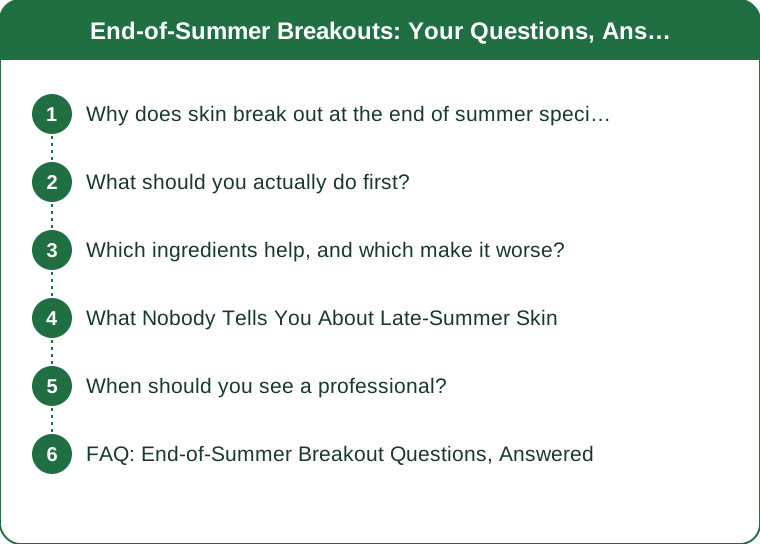
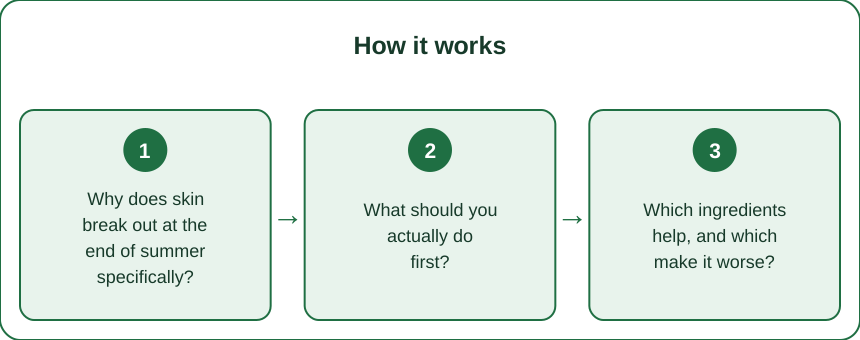
Why does skin break out at the end of summer specifically?
Several factors converge, and they are mostly cumulative rather than sudden.
Accumulated occlusion. Weeks of daily sunscreen, sweat, and sometimes heavier makeup add up. Individually none of these cause breakouts for most people; over eight or ten weeks the combination can.
Barrier disruption from sun exposure. Even without visible burning, sustained UV exposure affects skin barrier function. A compromised barrier means more water loss, more irritation, and skin that reacts to things it previously tolerated.
A humidity drop with no routine change. As the air dries out, a routine calibrated for humid July becomes inadequate - and skin that is dehydrated can produce more oil, not less, which is a common and counterintuitive contributor.
Sweat plus friction. Sweat itself is not comedogenic, and sweat trapped under clothing, hats, or a mask, combined with friction, produces a specific pattern of breakouts along the hairline, jaw, back and chest.
Reintroduced heavier products. As the weather cools, people return to richer creams. A cream that was fine last winter can break you out now if your barrier is already compromised.
And hormonal timing is worth ruling in or out. Breakouts that recur on the same part of the face at the same point in your cycle are a different problem with different solutions.
What should you actually do first?
Simplify. This is the counterintuitive part and it is the most important one.
Strip the routine back for two weeks: a gentle cleanser, a simple moisturiser, and sunscreen. Stop all actives - acids, retinoids, vitamin C, treatments.
Why this works: the most common cause of persistent late-summer breakouts is a damaged barrier being treated as an oil problem. Adding more actives to irritated skin produces more irritation, which produces more breakouts, which prompts more actives. Breaking that loop requires stopping, not adding.
What barrier damage looks like: stinging when you apply products that used to be fine, tightness, flaking alongside oiliness, redness, and skin that reacts to everything. If any of those are present, the barrier is the priority.
The two weeks are not wasted time. Barrier recovery generally takes days to a few weeks with a simple routine, and it is the foundation for everything you do afterwards.
What to keep: sunscreen, every day, without exception. Stopping sunscreen because of breakouts trades one problem for a worse one - and if your sunscreen is genuinely the trigger, changing the formula is the answer, not stopping.
Then reintroduce one active at a time, two weeks apart. Slower than anyone wants. It is the only way to identify what your skin actually tolerates, and it saves months.
Which ingredients help, and which make it worse?
The useful list is shorter than the shelf implies.
Genuinely useful for breakouts:
- Salicylic acid (BHA). Oil-soluble, so it works inside the pore. Best for congestion, blackheads, and clogged texture. Start at two or three times a week.
- Benzoyl peroxide. Effective against the bacteria involved in inflammatory acne. Drying and it bleaches fabric - start low and short-contact if you are sensitive.
- Adapalene, a retinoid available over the counter in many places. Among the better-evidenced options for acne, and it takes 8 to 12 weeks. Expect an initial worsening period.
- Azelaic acid. Gentler than most, and useful when there is redness and post-inflammatory marking alongside breakouts.
- Niacinamide. Well-tolerated, supports the barrier, and helps with oil and redness.
Useful for the barrier: ceramides, glycerin, hyaluronic acid, panthenol, squalane. These are not treating the acne and they are what makes treating the acne tolerable.
What makes it worse:
- Using several actives at once. The most common self-inflicted cause.
- Physical scrubs on inflamed skin.
- Alcohol-heavy toners and astringents, which strip and rebound.
- Picking, which converts a temporary spot into a mark that lasts months.
- Changing products every week. Nothing gets a fair trial and you cannot identify the culprit.
On heavier autumn creams: switch back gradually rather than all at once, and if a richer cream coincides with congestion, that is a strong signal.

What Nobody Tells You About Late-Summer Skin
Sunscreen is more likely to be a texture problem than a breakout cause. Heavy occlusive sunscreen formulas can contribute to congestion, and the answer is a different formula - fluid, gel, or one labelled non-comedogenic - not less sunscreen. The sun damage trade is not worth making.
Double cleansing matters more in summer than winter, specifically because sunscreen is designed to resist water. A single water-based cleanse frequently does not remove it fully, and residue accumulating over weeks is a plausible contributor to end-of-season congestion.
Sun exposure appears to improve acne short-term and worsen it afterward. UV has a temporary anti-inflammatory effect that masks acne, followed by thickening of the outer skin layer that can increase congestion weeks later. This is a good candidate explanation for why breakouts appear at the end of summer rather than during it.
Post-inflammatory marks are made much worse by sun. The dark marks left after a spot heals darken and persist longer with UV exposure, which is another argument for daily sunscreen specifically for anyone with active breakouts.
Your pillowcase and phone are real but minor. Worth changing and cleaning; not worth treating as the primary cause.
Skin takes about a month to show the results of a change. Skin cell turnover means today’s breakout reflects conditions from a few weeks ago, which is why the end of summer is when July’s accumulation appears - and why judging a new product after a week is meaningless.
And the one worth acting on: persistent, painful, or scarring acne deserves a dermatologist rather than another shelf product. Prescription treatments are substantially more effective than anything available over the counter, and delaying while trying products can allow scarring that is much harder to treat than the acne was. This is general information, not medical advice.
When should you see a professional?
Some breakouts are a routine problem. Some are not, and the distinction is worth knowing.
Reasonable to manage yourself:
- Occasional spots, mild congestion, blackheads
- Breakouts clearly linked to an identifiable trigger
- Mild breakouts responding to a simplified routine within a few weeks
Worth seeing a doctor or dermatologist:
- Painful, deep, or cystic spots - these are the ones most likely to scar
- Breakouts that have not improved after 8 to 12 weeks of consistent appropriate treatment
- Any scarring, even mild
- Acne significantly affecting your mood, confidence, or daily life - this is a legitimate reason on its own and is treated as one
- Sudden severe acne in adulthood, particularly with other changes like irregular periods or excess hair growth, which warrants investigation
- Breakouts alongside significant redness and flushing, which may be a different condition
What a professional adds: prescription topical and oral options, hormonal treatments, and an accurate diagnosis. A meaningful share of what people self-treat as acne is something else - rosacea, folliculitis, perioral dermatitis - and each needs a different approach. Treating the wrong condition for months is a common outcome of self-diagnosis. This is general information, not medical advice.
FAQ: End-of-Summer Breakout Questions, Answered
Why is my skin oily and flaky at the same time?
That combination usually indicates a compromised barrier and dehydration rather than genuinely oily skin. Simplify, restore, and avoid stripping products - adding more actives makes it worse.
Should I stop wearing sunscreen if it is breaking me out?
No. Change the formula. Fluid, gel, and mineral formulas suit different skins, and finding one that agrees with you is worth the trial.
How long before a new routine shows results?
Eight to twelve weeks for actives. Barrier improvements from simplifying can show within one to two weeks, which is why simplifying first is satisfying as well as effective.
Is it purging or is it breaking out?
Purging happens with ingredients that speed cell turnover, appears where you usually break out, and settles within four to six weeks. Breakouts in new areas, or irritation persisting beyond six weeks, is a reaction rather than purging.
Does diet cause breakouts?
Evidence is strongest for high-glycaemic diets and, in some studies, skim milk having a modest association with acne. It is one factor among several and rarely the whole story - dietary change alone is not a substitute for treatment.
TL;DR:
- Late-summer breakouts are cumulative: weeks of sunscreen and sweat, sun-compromised barrier, drier air
- Simplify first - cleanser, moisturiser, sunscreen only - for two weeks before adding anything
- Oily-and-flaky together means barrier damage, not an oil problem; more actives make it worse
- Reintroduce one active at a time, two weeks apart, and give it 8 to 12 weeks to judge
- Painful, cystic, or scarring acne deserves a dermatologist rather than another shelf product
Today’s skin reflects a few weeks ago. That is why July shows up in August.
Keep Reading
This article is for general informational purposes only and is not medical advice. Always consult a qualified health professional for guidance specific to you.