End-of-Summer Breakout Questions, Answered
Quick Answer: Late-summer breakouts are usually congestion rather than inflammation — a season of sunscreen, sweat, and heavier humidity building up in the pores. Do not escalate to strong actives on already-stressed skin. Change one thing: how thoroughly you cleanse at night, then reassess in two weeks.
Your skin was fine in June. By late August it is bumpy across the forehead and cheeks with a few deeper spots that will not surface.
That pattern is specific, it is seasonal, and it responds to different things than a hormonal or a stress breakout does.

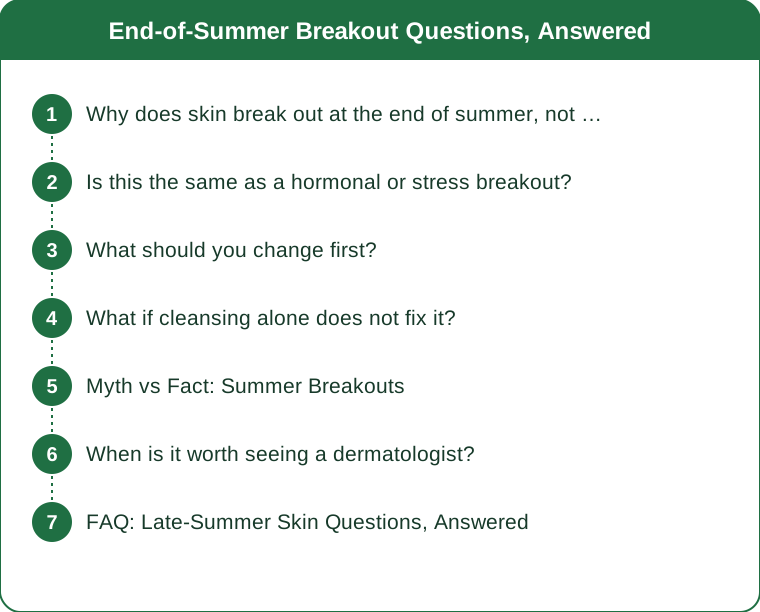
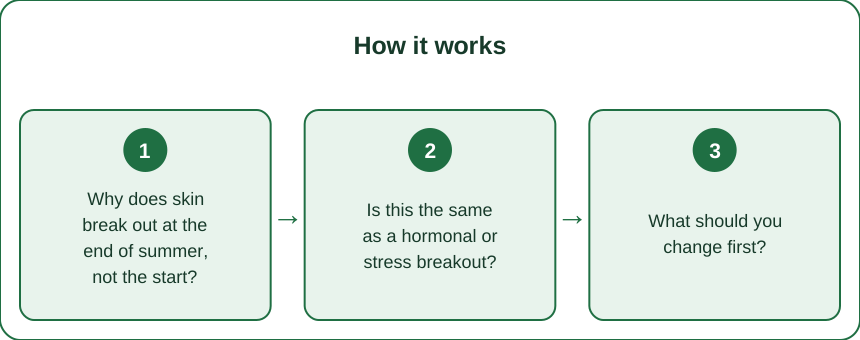
Why does skin break out at the end of summer, not the start?
Because it is cumulative. A single hot day does not congest skin; twelve weeks of daily sunscreen, sweat, and humidity does.
Three things stack across a summer. Sebum production increases in heat — for many people noticeably. Humidity slows evaporation from the skin surface, so sweat, sunscreen, and oil sit longer instead of drying off. And sunscreen use, which is genuinely non-negotiable, means a daily occlusive layer that gets reapplied over sweat rather than over clean skin.
None of those are problems on their own. Together, over a season, they produce congestion: closed comedones, small bumps that are not red or painful, and the occasional deeper cyst where a congested pore got inflamed.
That is why it shows up in week ten and not week one. The skin was managing until the backlog exceeded what nightly cleansing was clearing.
Is this the same as a hormonal or stress breakout?
No, and treating them the same is why people escalate to the wrong product.
Congestion breakouts are typically small, skin-colored or slightly white, spread across a broad area — forehead, temples, cheeks — and not especially painful. They feel like texture more than spots.
Hormonal breakouts cluster along the jawline and lower cheeks, tend to be deeper and tender, and often track a predictable point in the cycle.
Stress breakouts appear fast, are inflamed and red, and usually show up where you already tend to break out.
Late-summer skin frequently has congestion plus a few inflamed spots on top, which reads as “my skin got worse” and prompts a jump to benzoyl peroxide across the whole face. That treats the minority of the problem and dries out the majority of it.
Identify which one dominates before you change anything. If the answer is broad, non-painful texture, this article’s approach applies.
What should you change first?
One thing, and it is almost always the same one: how you cleanse at night.
A full day of water-resistant sunscreen, sweat, and sebum does not fully come off with a single pass of a gentle gel cleanser. That is not a criticism of the cleanser — water-resistant sunscreen is specifically formulated to resist water.
The fix is a double cleanse on days you wore sunscreen, which in summer is every day:
- An oil, balm, or micellar first pass on dry skin, worked in for a full 30 to 60 seconds. This is the step that dissolves sunscreen and sebum.
- Your normal cleanser second, on damp skin, 30 seconds.
Do this for two weeks before you change anything else. It resolves a meaningful share of late-summer congestion on its own, and it does not stress the skin barrier the way adding an active does.
One caveat: do not scrub, and do not use a brush. Congestion is not dirt, and mechanical aggression makes the inflamed spots worse.

What if cleansing alone does not fix it?
Give it two weeks, then add one thing — not three.
The most useful single addition for congestion is a BHA (salicylic acid), because it is oil-soluble and works inside the pore rather than just on the surface. Start at 2 percent, two nights a week, and build to every other night if your skin tolerates it. Applied to dry skin, on the congested areas, not the whole face.
If your skin is dry or reactive, a gentle AHA such as mandelic acid is easier to tolerate, though slightly less effective for pore congestion specifically.
What not to do in the same two weeks: add retinol, add a clay mask routine, add an exfoliating toner, and switch moisturizers. When four things change at once and skin gets worse, you have no idea which one to remove.
Adjust the moisturizer instead of dropping it. A common late-summer error is skipping moisturizer because skin feels oily. Dehydrated skin produces more oil, so the shortcut backfires. Switch to a lighter gel-cream rather than skipping the step.
Myth vs Fact: Summer Breakouts
Myth: Sunscreen causes breakouts, so skip it when you are broken out. Fact: Sun exposure worsens post-inflammatory marks significantly and does not clear acne — the apparent summer improvement some people see is tanning masking redness. The fix is a lighter or different sunscreen, never no sunscreen.
Myth: Sweating cleans out your pores. Fact: Sweat does not flush pores; it sits on top and mixes with sebum and sunscreen. Sweat itself is not the problem — sweat left to dry on the skin is. Rinse within an hour of a workout when you can.
Myth: Oily skin does not need moisturizer in summer. Fact: Skipping it drives compensatory oil production in a lot of people. Lighter texture, same step.
Myth: Congestion needs stronger exfoliation. Fact: Over-exfoliating is one of the most common causes of a late-summer breakout that will not resolve. If you are already exfoliating three-plus times a week and things are worse, the answer is less, not more.
Myth: It will clear up on its own when the weather cools. Fact: Often partly true — but congestion that has been building for three months takes weeks to clear even after conditions improve, and deeper cysts can scar in the meantime.
When is it worth seeing a dermatologist?
Most seasonal congestion resolves with the cleansing change plus time. Some does not, and there is no benefit to a long solo trial.
Worth making an appointment if:
- Spots are deep, painful, and leaving marks or scars — cystic acne responds to prescription treatment and scars are much easier to prevent than to fix
- Nothing has improved after 8 to 12 weeks of a consistent routine
- The breakouts are affecting how you feel about going out or being seen
- You are pregnant or trying to conceive and unsure which actives are appropriate
- The pattern changed suddenly and dramatically, or came with other symptoms such as unusual hair growth or cycle changes
Over-the-counter routines have a genuine ceiling, and prescription options — topical retinoids, azelaic acid, hormonal treatments, and others — work on mechanisms that shelf products cannot reach.
This is general information, not medical advice. A dermatologist can assess what is actually happening on your skin rather than what a category description suggests.
FAQ: Late-Summer Skin Questions, Answered
How long until the cleansing change shows results?
Surface texture usually improves within 10 to 14 days. Deeper congestion that formed weeks ago takes 4 to 6 weeks to clear, because that is the timeline of the pore turnover involved. Judge at two weeks, decide at six.
Should I switch to a lighter sunscreen?
If your current one is a thick cream and you are congested, yes — a fluid, gel, or lightweight mineral formula is often better tolerated. Look for non-comedogenic labeling, and reapply over blotted skin rather than over a layer of sweat.
Can I use a clay mask to speed this up?
Once a week, on congested areas, is fine and can help a little. Two or three times a week, all over, is how people end up with a compromised barrier in September — which produces a longer and more stubborn breakout than the one they started with.
TL;DR: Late-summer breakouts are congestion built up over a season, not a new skin problem.
- Twelve weeks of sunscreen, sweat, and humidity accumulate faster than one nightly cleanse clears.
- Broad, non-painful texture is congestion; jawline and tender is hormonal; fast and red is stress. Identify which dominates.
- Fix the night cleanse first — an oil or balm pass on dry skin, then your normal cleanser. Two weeks before changing anything else.
- Then add one thing, ideally a 2% BHA twice weekly. Not four things at once.
- Keep moisturizing with a lighter texture, and never drop sunscreen.
- See a dermatologist for deep painful spots, scarring, or no change after 8 to 12 weeks.
The restraint is the strategy here. Stressed skin plus escalation is how a three-week problem becomes a three-month one.
Keep Reading
This article is for general informational purposes only and is not medical advice. Always consult a qualified health professional for guidance specific to you.