Does Hard Water Affect Your Skin, and What Can You Actually Do?
Quick Answer: Hard water does not directly cause acne, but it makes cleansers harder to rinse and leaves a mineral and soap residue that can irritate the skin barrier - which contributes to dryness, tightness, and sensitivity, and can worsen eczema. The evidence is strongest for eczema in children and weakest for acne. A shower filter helps modestly; switching to a low-foaming, pH-balanced cleanser helps more and costs less.
You moved, or you visited somewhere, and your skin behaved differently for no reason you can identify. Water hardness is one of the least discussed variables in skincare and one of the few that changes when you change postcode.
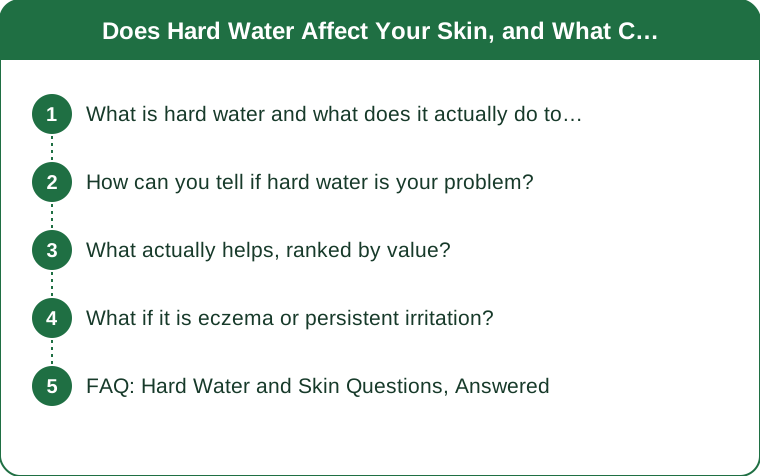
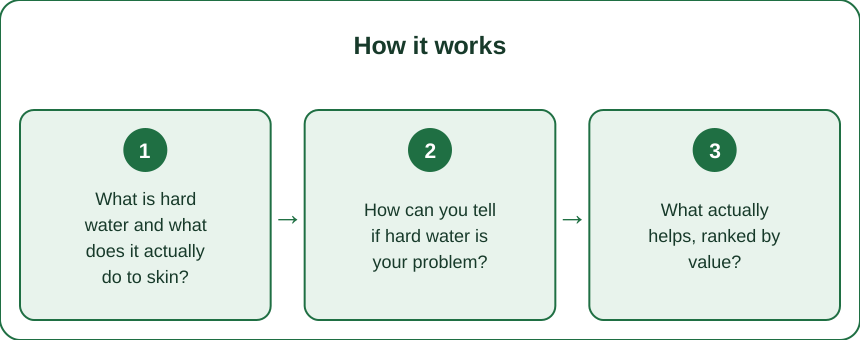
What is hard water and what does it actually do to skin?
Hard water contains high levels of dissolved minerals, primarily calcium and magnesium, picked up as groundwater passes through chalk and limestone. Whether you have it is determined entirely by geology, and most water suppliers publish a hardness figure for your postcode.
The primary mechanism is soap scum. Calcium and magnesium ions react with the surfactants in traditional soaps to form an insoluble residue. That is the film on your shower screen, and a version of it forms on your skin. It is difficult to rinse away, it sits on the surface, and it can disrupt the skin barrier.
The second mechanism is barrier disruption. Research has found associations between water hardness and skin barrier impairment, with the strongest evidence in eczema - particularly in infants and children, where hard water exposure has been associated with higher rates of atopic dermatitis. The proposed pathway involves both the residue itself and the increased amount of cleanser people use when it does not lather well.
The third is pH. Hard water tends to be more alkaline, while healthy skin sits at a mildly acidic pH of roughly 4.7 to 5.5. Washing with alkaline water and alkaline soap raises skin pH temporarily, which affects the enzymes involved in barrier maintenance and the balance of skin microbes.
What it is not: a direct cause of acne. Acne is driven by sebum production, follicular keratinisation, bacteria, and hormones. Hard water does not create those. It can contribute to a compromised, irritated barrier, and irritated skin tolerates acne treatments less well - which is an indirect route worth understanding, but it is not the same as causing breakouts.
How can you tell if hard water is your problem?
Several signs point at water rather than product, and they are fairly distinctive.
In the house:
- White limescale on taps, kettles, and shower heads
- Soap that will not lather without a lot of product
- A film on the shower screen and glassware
- Towels and clothes that feel stiff after washing
On your skin:
- Tightness immediately after washing, before applying anything
- A squeaky feeling, which is barrier stripping rather than cleanliness
- Dryness that improved noticeably on holiday somewhere else
- Hair that feels coated, dull, or difficult to rinse
The strongest single clue is the location test. If your skin behaves noticeably better when you stay somewhere else, and worse when you return, and your products have not changed, water is a reasonable suspect.
Check the actual figure. Your water supplier’s website will give hardness in either milligrams per litre of calcium carbonate or in degrees. Broadly, above roughly 200 mg/l is hard, and above 300 is very hard. Knowing the number tells you whether this is a plausible explanation or a distraction.
And rule out the ordinary things first. A new cleanser, over-exfoliation, a change in ambient humidity, or simply washing too often all produce identical symptoms and are far more common.

What actually helps, ranked by value?
In order of benefit per pound spent, which is not the order the internet usually presents.
1. Change your cleanser. Traditional soap and high-foaming surfactants are what react with the minerals. A low-foaming, pH-balanced cream, gel, or oil cleanser produces far less residue in hard water. This is the highest-impact change and it costs the price of one product.
2. Rinse with filtered or bottled water for the final rinse only. A small amount of soft water as the last step removes the residue without a plumbing project. Micellar water on a cotton pad as a final wipe achieves something similar.
3. Use a leave-on acidic product. A toner or serum in the pH 4 to 5 range helps restore surface pH after an alkaline wash. This is one of the more genuinely useful roles for a toner.
4. Moisturise on damp skin, within a minute. Barrier support matters more when the barrier is being challenged. Look for ceramides, glycerin, and squalane.
5. A shower filter. Genuinely helps with hair feel and reduces skin residue for many people, but effectiveness varies considerably by type and they need replacing on schedule. Reasonable to try after the cheaper steps.
6. A whole-house water softener. The most effective option and by far the most expensive. It removes the minerals at source and fixes everything downstream. Worth considering if you have very hard water and someone in the household has eczema - though it is worth knowing that a large UK trial found softeners did not significantly improve eczema severity in children who already had it, even though hardness is associated with developing it in the first place.
What if it is eczema or persistent irritation?
Then water hardness is one variable among several, and the management is broader than a filter.
Shorten and cool the showers. Hot water strips lipids regardless of hardness, and long hot showers are frequently the larger factor. Five to ten minutes, warm rather than hot.
Reduce cleanser contact. Not every part of the body needs cleanser every day. Underarms, groin, feet, face - the rest often needs only water. This meaningfully reduces total residue exposure.
Use an emollient wash instead of soap if you have eczema-prone skin. These are designed to clean without surfactants that react with hard water minerals.
Apply moisturiser within about three minutes of getting out, on skin that is still slightly damp, to trap water in the stratum corneum.
Look at laundry too. Hard water leaves detergent residue in fabric, and stiff towels and bedding against irritated skin is a real contributor. An extra rinse cycle and less detergent both help.
And see a doctor or dermatologist if: the skin is cracked, weeping, bleeding, or infected-looking; itching is disturbing sleep; a rash is spreading or not responding to over-the-counter emollients after two weeks; or acne is scarring. Persistent eczema and moderate to severe acne both have effective prescription treatments, and water quality is not a substitute for them. This is general information, not medical advice.
FAQ: Hard Water and Skin Questions, Answered
Does hard water cause acne?
Not directly. It can impair the skin barrier and leave residue, which makes skin more easily irritated and less tolerant of acne treatments, but the drivers of acne are sebum, follicular blockage, bacteria, and hormones.
Do shower filters actually work?
They reduce residue and many people notice a real difference in hair and skin feel. Effectiveness varies by filter type and they need regular replacement. Changing your cleanser usually delivers more benefit for less money.
Why does my skin feel tight after washing?
Usually barrier stripping - from an alkaline or high-foaming cleanser, hot water, or mineral and soap residue in hard water. A squeaky-clean feeling is a sign the wash was too harsh, not that it worked.
TL;DR:
- Hard water leaves mineral and soap residue that irritates the barrier and raises skin pH.
- The evidence is strongest for eczema, and hard water does not directly cause acne.
- Switching to a low-foaming pH-balanced cleanser beats a filter for cost and effect.
- Shorter cooler showers, a soft final rinse, and moisturising on damp skin do most of the rest.
If your skin has been better on holiday for years and you blamed the sunshine, it may have been the plumbing.
Keep Reading
This article is for general informational purposes only and is not medical advice. Always consult a qualified health professional for guidance specific to you.