Does Changing Your Pillowcase More Often Actually Help Acne? Your Questions, Answered
Quick Answer: A clean pillowcase reduces the transfer of oil, product residue, sweat, and bacteria back onto your face, which plausibly helps if you are getting breakouts along the side of the face you sleep on. It does not address hormonal acne, and there is limited direct research on frequency. Changing it twice a week is a reasonable target; silk versus cotton matters far less than clean versus not clean.
It is worth doing and it is not a treatment. Those two things are both true and the internet tends to pick one.
This is general information rather than medical advice.

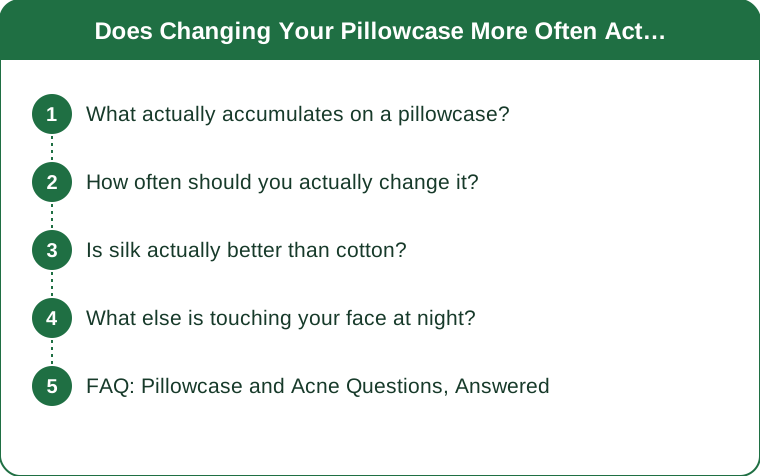
What actually accumulates on a pillowcase?
More than people assume, and most of it comes from you.
In a week of use, a pillowcase collects:
- Sebum, transferred directly from face and hair. This is the main one
- Hair products. Oils, waxes, dry shampoo, and leave-in conditioners migrate onto the fabric and then back onto your face. For people who use heavy hair products, this is frequently the largest single factor
- Skincare residue, particularly heavier night creams and oils
- Sweat and dead skin cells
- Bacteria and, over longer periods, fungal organisms, which is a routine feature of any fabric in contact with skin
- Detergent and fabric softener residue, which is a genuine and underrecognised irritant
What the accumulation plausibly does. Reapplying oil and product residue to your face for seven or eight hours a night is a reasonable mechanism for contributing to congestion, particularly on the side you sleep on. What is much less clear is how large the effect is compared with hormones, genetics, and the rest of your routine.
The honest state of the evidence. There is very little direct research on pillowcase changing frequency and acne outcomes. The advice is mechanistically reasonable and widely given by dermatologists as a supportive measure, and it is not backed by the kind of trial data that supports, say, topical retinoids.
The most useful diagnostic: if your breakouts are consistently on one side of your face - the side you sleep on - contact factors including the pillowcase are worth taking seriously. If they are symmetrical, along the jaw, and cyclical, something else is driving them.
How often should you actually change it?
Twice a week is a sensible target, and the right answer depends on what else is going on.
Reasonable frequencies:
- Every two to three days if you have active acne, oily skin, or you apply heavy products at night
- Twice a week as a general target for most people
- Weekly as a minimum baseline
- Daily is unnecessary for almost everyone and creates a laundry burden that makes the whole habit collapse
Practical systems that make it stick:
- Buy several pillowcases so a change never depends on a wash cycle. This is the single change that makes the habit sustainable
- Flip the pillowcase inside out halfway through, which gives you a clean surface without a wash. Not a substitute for washing and genuinely useful mid-week
- Use a clean towel over the pillow on nights you have applied a heavy treatment and change the towel daily. Cheaper than pillowcases and easier to wash
- Attach it to something existing - the night you take the bins out, or every Sunday and Wednesday
What to wash with. A fragrance-free, dye-free detergent, and skip the fabric softener - the residue it leaves is a common contact irritant and it also reduces absorbency. Wash hot enough to clean properly, and dry fully.
On hair, which matters more than the pillowcase. If you have oily hair or use heavy products, tying hair back at night removes a substantially larger source of transfer than a fresh pillowcase does. Washing your hair more often, or keeping it off your face at night, is likely more effective than any pillowcase strategy.

Is silk actually better than cotton?
For friction and hair, plausibly. For acne specifically, the evidence is thin.
What silk is genuinely credited with:
- Less friction, which is why it is popular for hair and for reducing sleep creases. This is the best-supported claim
- Less absorbency, meaning it pulls less moisture out of skin and hair. Also plausible
- A smoother surface, which some people with sensitive or eczema-prone skin find more comfortable
What is less clear:
- That it reduces acne. The absorbency argument cuts both ways: silk absorbs less oil, which means more oil stays on the surface in contact with your face. There is no strong evidence either direction
- That it is more hygienic. Silk requires gentler washing, often cooler temperatures, which is arguably less effective at cleaning
The practical view: a clean cotton pillowcase changed twice weekly is very likely better than a silk one changed fortnightly because it is delicate to wash. Frequency beats fabric.
If you want silk anyway, which is a perfectly reasonable choice for hair and comfort: buy several, use a gentle detergent, wash in a mesh bag, and keep the frequency up. Satin is a weave rather than a fibre and a polyester satin gives you a similar surface at a fraction of the cost, though it is less breathable.
One genuine consideration for anyone sleeping hot: silk and polyester satin both breathe less than cotton, and sweating more at night is not helpful for congestion. If you overheat in bed, cotton or bamboo is likely the better choice regardless of the marketing.
What else is touching your face at night?
Four things people never think about, and at least one of them is dirtier than the pillowcase.
Your phone. Held against the face, carried everywhere, and rarely cleaned. This is very likely a larger contact-transfer source than bedding for most people, and wiping it with an alcohol wipe a few times a week takes seconds. Breakouts on one cheek in a phone-shaped distribution are a real pattern.
Your hands. Sleeping with a hand against your face is extremely common and completely unnoticed. If you consistently break out in one specific patch, consider whether you wake up with your hand there.
Your duvet cover and top sheet, which are also in contact with the face for many sleepers and get changed far less often than pillowcases.
Hair, and hair products specifically. The single biggest source of transfer for many people. Leave-in conditioners, oils, and dry shampoo migrate onto the pillow and back onto the face and jaw. Breakouts along the hairline and temples are a strong signal for this, and tying hair back or switching to a lighter product often does more than any bedding change.
What none of this addresses. Hormonal acne along the jaw and chin, cyclical breakouts, and moderate to severe acne generally are not contact problems, and no amount of pillowcase hygiene will resolve them. Trying to fix hormonal acne with laundry is one of the more common ways people delay effective treatment, which for moderate acne typically means topical retinoids, benzoyl peroxide, or prescription options discussed with a doctor.
When to see someone: acne that is painful, nodular, leaving marks or scars, not responding to over-the-counter products after several months, or affecting how you feel day to day. Effective treatments exist and early treatment reduces scarring - that is the strongest argument for not spending six months on bedding optimisation first.
FAQ: Pillowcase and Acne Questions, Answered
How often should I change my pillowcase for acne?
Every two to three days with active acne, and twice a week as a general target. Weekly is a reasonable minimum. Daily is unnecessary and usually unsustainable.
Does a silk pillowcase help acne?
The evidence is thin. Silk has better support for reducing friction and hair damage. For acne, a clean cotton case changed frequently is likely better than a silk one changed rarely.
Can I just flip the pillowcase over?
As a mid-week measure, yes - it gives you a fresh surface. It does not replace washing.
Does fabric softener matter?
It leaves a residue that is a fairly common contact irritant and reduces absorbency. Fragrance-free, dye-free detergent and no softener is the better setup for skin.
What if my acne does not improve?
Contact factors only address contact-related congestion. Hormonal, cyclical, or moderate to severe acne needs actual treatment, and effective options exist - a doctor or dermatologist is the right next step rather than more laundry.
TL;DR:
- Pillowcases collect sebum, hair product, skincare residue, and sweat, and reapply them for eight hours a night
- Twice a week is a sensible target; every two to three days with active acne
- Frequency beats fabric - clean cotton beats rarely-washed silk
- Your phone, your hands, and your hair products are probably bigger contact sources than your bedding
- None of it treats hormonal acne, and spending months on bedding delays treatment that works
Worth doing, cheap to do, and not a substitute for treatment if the acne is moderate or persistent.
Keep Reading
This article is for general informational purposes only and is not medical advice. Always consult a qualified health professional for guidance specific to you.