Body Acne Questions, Answered (Because It's Not the Same as Facial Acne)
Quick Answer: Body acne (back, chest, shoulders) is frequently driven more by friction, sweat retention, and thicker skin producing more oil than facial acne is, which means the most effective fixes often center on post-workout hygiene timing and fabric choice rather than the facial skincare routine adjustments most acne advice assumes.
Most acne content defaults to facial skincare — cleansers, serums, spot treatments — but body acne responds to a partly different set of triggers, which is exactly why facial routines often don’t translate well when applied to the back or chest.

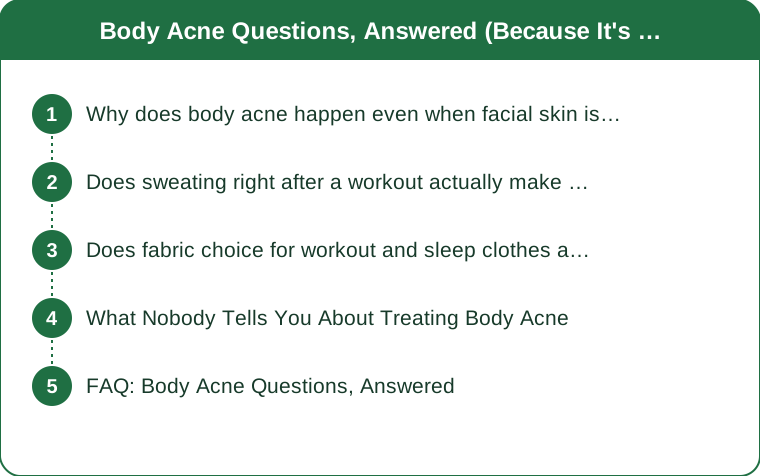
Why does body acne happen even when facial skin is clear?
Skin on the back, chest, and shoulders is thicker and contains more oil-producing glands per area than facial skin, and these areas are also far more prone to friction and prolonged sweat contact from workout gear, backpacks, and bra straps — a combination facial skin doesn’t experience nearly as consistently.
This means someone can have a genuinely well-managed facial routine and still struggle with body acne, since the drivers are meaningfully different, not just a smaller-scale version of the same problem.
Does sweating right after a workout actually make it worse?
Yes, specifically when sweat and friction from tight workout fabric sit against skin for an extended period post-workout — this combination is one of the most common and directly fixable triggers for back and chest acne, more so than diet or general hygiene habits.
Showering promptly after sweating (rather than sitting in workout clothes for hours) meaningfully reduces this specific trigger, and it’s one of the highest-impact changes for body acne specifically.

Does fabric choice for workout and sleep clothes actually matter?
Yes — moisture-wicking, breathable fabrics reduce the prolonged sweat-and-friction combination that irritates body acne-prone skin, while fabrics that trap moisture against skin (some cotton blends, especially when damp) tend to worsen the friction-and-bacteria environment that drives breakouts in these areas.
What Nobody Tells You About Treating Body Acne
Facial-strength active ingredients (salicylic acid, benzoyl peroxide) generally need to be used at a similar or sometimes slightly higher concentration on body skin, since it’s thicker and less sensitive than facial skin — a product specifically formulated as a body acne wash, used consistently in the shower, often outperforms trying to apply facial spot treatments across a larger body area.
Body acne can also take visibly longer to respond to treatment changes than facial acne, partly due to that thicker skin, so it’s worth giving a new routine 8-12 weeks before judging effectiveness, longer than the timeline often expected for facial products.
FAQ: Body Acne Questions, Answered
Is body acne caused by diet the same way people believe facial acne is?
The diet-acne connection isn’t dramatically different by body location, though the friction and sweat factors specific to body acne often matter more practically day-to-day than dietary triggers for these particular areas.
Should I switch laundry detergent if I have body acne?
If you notice a pattern connecting new detergent to breakouts, a fragrance-free, dye-free option is a reasonable low-cost thing to try, since detergent residue can occasionally irritate acne-prone skin on the body.
Is it okay to use body acne wash daily, or is that too harsh?
Most body acne washes with salicylic acid or benzoyl peroxide are formulated for daily use on body skin’s naturally thicker, less sensitive surface, though starting every-other-day and increasing if tolerated is a reasonable, cautious approach.
TL;DR:
- Body acne is driven more by friction, sweat retention, and thicker oilier skin than facial acne is
- Showering promptly after sweating is one of the highest-impact, most specific fixes
- Breathable, moisture-wicking fabric choices for workout and sleep clothes genuinely help
- Body skin often needs 8-12 weeks to show real improvement, longer than typical facial timelines
Body acne deserves its own approach, not a scaled-up version of a facial routine — the triggers really are different. This is general information, not medical advice.
Keep Reading
This article is for general informational purposes only and is not medical advice. Always consult a qualified health professional for guidance specific to you.