Adult Acne vs Teen Acne: Every Difference Explained
Quick Answer: Adult acne tends to cluster around the jawline and chin, is more often hormonally driven and cycle-linked, and responds differently to treatment than teen acne, which is more commonly driven by increased oil production across the whole face during puberty.
You did everything that cleared your skin at 16 and it’s not working at 30. That’s not a failure of effort — adult acne and teen acne are different enough in cause and pattern that the same routine often can’t be expected to work the same way.
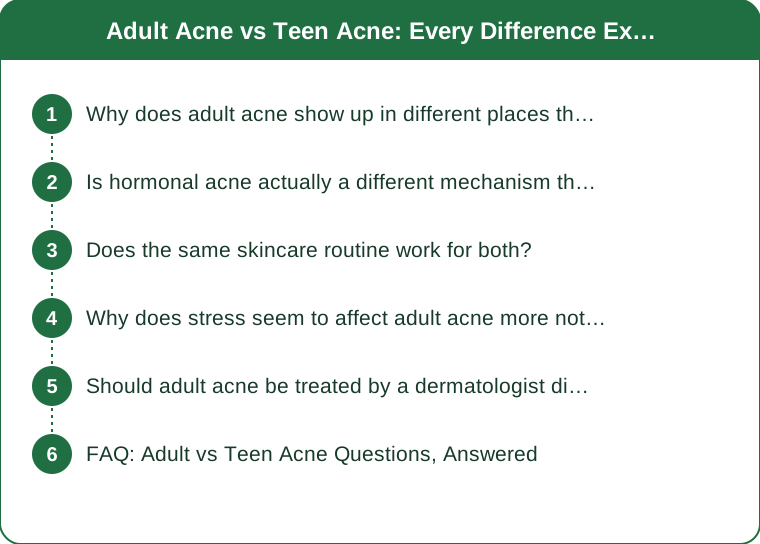
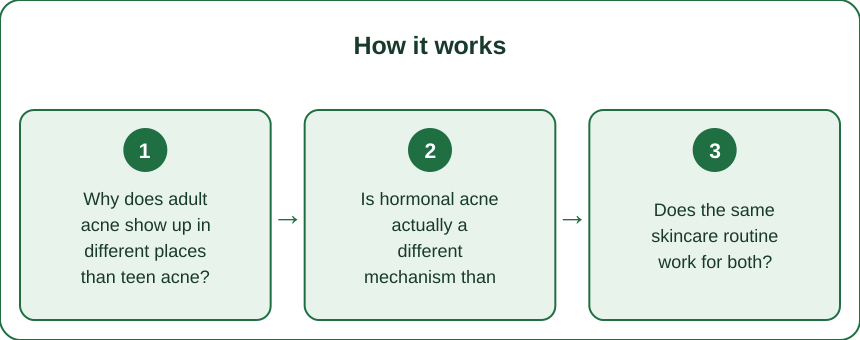
Why does adult acne show up in different places than teen acne?
Teen acne tends to appear broadly across the forehead, nose, and cheeks, driven by generally elevated oil production during puberty. Adult acne clusters more often along the jawline, chin, and lower face — a pattern strongly associated with hormonal fluctuation, particularly around the menstrual cycle, which is why it often flares predictably at the same point each month.
Is hormonal acne actually a different mechanism than teen acne?
Both involve oil production and clogged pores, but adult hormonal acne is more specifically tied to fluctuations in androgen sensitivity around ovulation and the days before a period, whereas teen acne is more consistently driven by baseline oil production increases during puberty. This is part of why adult acne can feel cyclical in a way that teen acne often wasn’t.
Does the same skincare routine work for both?
Not always — ingredients that worked well for excess-oil, whole-face teen acne (stronger benzoyl peroxide, for example) can be too drying and irritating for adult skin, which is often also dealing with early signs of aging and increased sensitivity. Adult routines often shift toward gentler exfoliation (niacinamide, lower-strength retinoids) paired with hormonal-pattern awareness rather than aggressive oil-stripping alone.

Why does stress seem to affect adult acne more noticeably?
Cortisol, the primary stress hormone, can influence oil production and inflammation — and adult life often carries more chronic, ongoing stress sources (work, caregiving, sleep disruption) than the more episodic stress of teen years. This is part of why adult breakouts sometimes track more closely with stressful weeks than diet alone.
Should adult acne be treated by a dermatologist differently than teen acne was?
Often yes — a dermatologist evaluating adult acne may consider hormonal testing or hormonally-targeted treatment options (like certain birth control formulations or spironolactone) that aren’t typically first-line for teen acne, since the underlying driver is frequently different even when the visible breakout looks similar.
FAQ: Adult vs Teen Acne Questions, Answered
Can adult acne go away on its own like some teen acne does?
It’s less predictable — some adult acne is tied to a specific life stage (postpartum, perimenopause) and shifts with it, but it doesn’t reliably resolve the way some teen acne fades after puberty.
Why did my skin stay clear through my 20s and start breaking out now?
Hormonal shifts — a new birth control, postpartum changes, or approaching perimenopause — are common triggers for acne that wasn’t present in earlier adult years.
Is it worth switching skincare brands entirely for adult acne?
Not necessarily the brand, but the ingredient focus — shifting from oil-control-heavy teen products toward gentler, hormonally-aware routines is usually more effective than brand-switching alone.
TL;DR:
- Adult acne clusters at the jawline and chin; teen acne spreads more broadly
- Adult acne is more often cycle-linked and hormonally driven
- Gentler, less oil-stripping routines usually suit adult skin better
- Stress and chronic life factors show up more visibly in adult breakout patterns
This is general information, not medical advice — a dermatologist can evaluate persistent or cystic adult acne for hormonal or prescription treatment options.
See It in Motion
Seen here: Maternity Capris with Side Pockets — shop it on bubblelime.com
Keep Reading
This article is for general informational purposes only and is not medical advice. Always consult a qualified health professional for guidance specific to you.